
Inside Tiny House: everyday objects you can explore in gugiboard
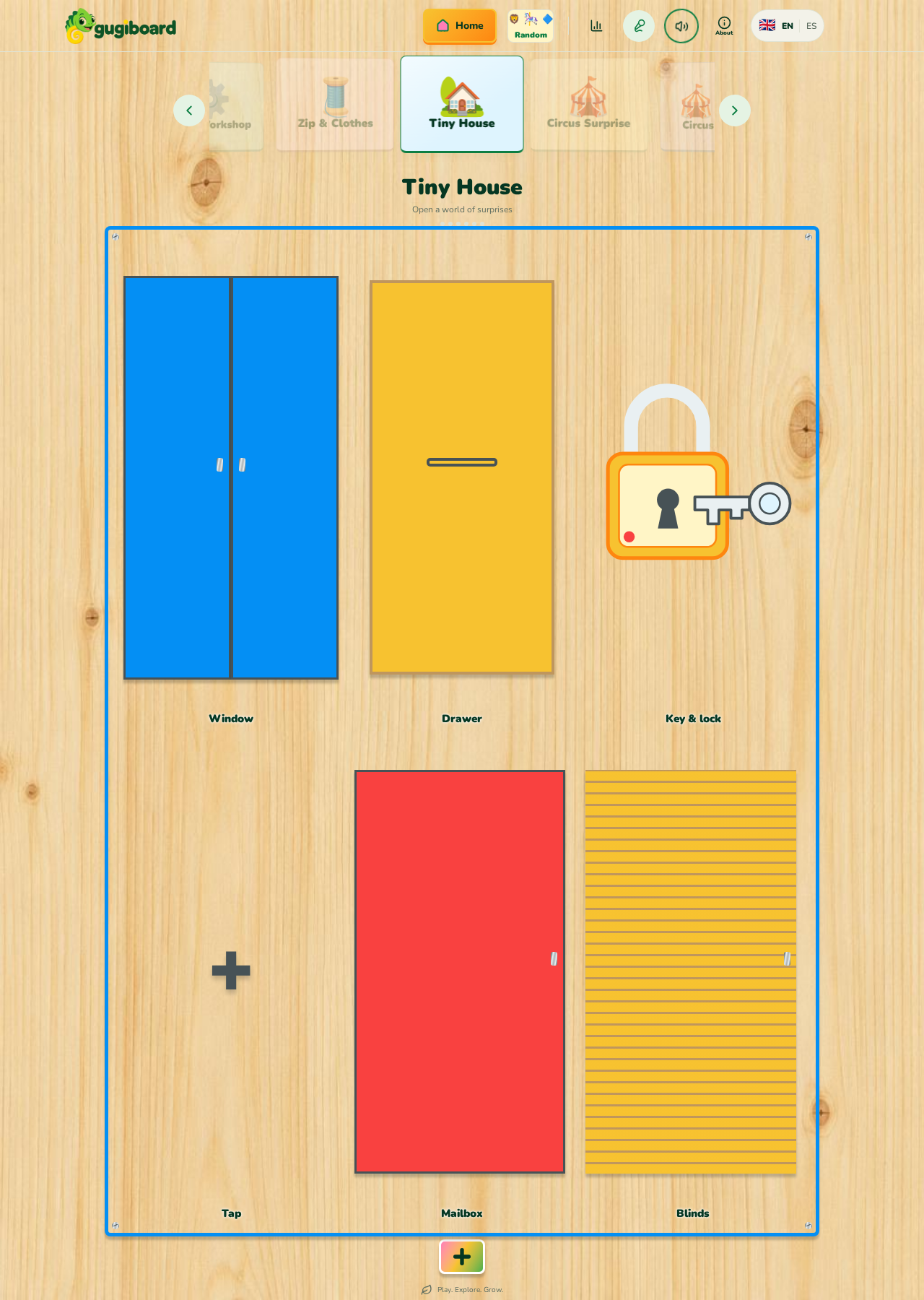
A home contains many small actions that adults barely notice: opening a drawer, lifting a blind or turning a tap. Tiny House makes a few of those actions the subject of play. Within gugiboard’s free platform, it combines interactive household pictures with a colorful + sheet of daily moments. The convenience is seeing related ideas together, not reproducing a real home or teaching safety through animation.
Six corners of a little house
The main sheet shows a window, drawer, key and lock, tap, mailbox and blinds. These objects offer different responses to touch. Pick something your child recognizes and describe one visible detail. “The drawer opens” is enough to start. It is fine to revisit the same object rather than treating the board as a checklist to complete.
Open and closed are visible changes
Some household pictures become open or closed during play, and their live controls can be enlarged while preserving that state. This gives a family a clear before-and-after example. Instead of asking for an explanation, comment on what changed and wait. A repeated action can be enjoyable on its own; it does not need to become a lesson every time.
A second sheet for familiar moments
The colorful + changes the objects to six routine scenes: waking up, brushing teeth, washing hands, bathing, getting dressed and going to sleep. They are animated pictures of daily moments, not a personalized timetable. Choose the moment relevant to your family today and explain what happens in your actual home, where routines and support may look different.
Describe a home in either language
Labels and prepared spoken words follow the English–Spanish choice. Window and ventana refer to the same picture, and drawer and cajón give another simple pair. Use a short natural sentence around the word. The advantage is changing language within a familiar activity, rather than opening a separate lesson; there is no need to translate every turn or demand repetition.
Explore a safe real-world example
After screen play, an adult can show an accessible drawer and explain what is stored there. Keep fingers clear of closing edges and do not invite children to operate locks, windows, blinds or taps alone. Blind cords, hot water and access to outside spaces carry real risks that the virtual board does not reproduce. Supervision matters more than imitation.
Use the house as a starting point
Tiny House can prompt a conversation before a real routine, but it is not a substitute for brushing teeth or washing hands. End the optional screen moment and do the activity together. Home is always available, and muting is possible. For babies, prioritize real interaction and care; the platform’s stated 0–7 audience does not recommend screens from birth.
Source and privacy
More play ideas
- Toddler browser games: a caregiver’s guide to shared play
- Colors and shapes for toddlers: simple ways to play together
- English and Spanish animal play: words, sounds and movement
- Play that moves on by itself: auto-advance and idle friends
- See what your toddler taps most—and hide it with one tap
- A visual tour of gugiboard: boards, Baby Games and Little favorites
- First words with jungle animals: lion, elephant, monkey and friends
- Alphabet play in two languages: from A for Apple to Ñ
- Happy, sad, surprised: naming feelings with toddlers
- Eyes, nose, hands: body parts games for toddlers
- Kindness through play: rescue stories for little helpers
- Cause and effect: why busy boards fascinate babies
- Music and sounds for babies: instruments, animals and soft songs
- Wake up to bedtime: teaching daily routines with Tiny House
- Tap, drag, draw: little fingers and fine motor play
- Healthy screen habits for toddlers: short, shared and balanced
- Play ideas by age: how gugiboard grows with your child from 0 to 7
- Counting with stars: first numbers through play
- Red, blue, yellow: learning colors step by step
- Circles, stars and hearts: finding shapes all around us
- Raising bilingual children at home: simple daily habits
- Sensory play for babies: lights, sounds and gentle movement
- gugiboard for children aged 4 to 7: from play to early learning
- “Great job!”: celebrating effort, not just results
- Calm moments: helping little ones through big feelings
- Meet the gugiboard chameleon: friendly characters that invite play
- From an animal picture to a story: reading picture books together
- Your turn, my turn: sharing play without a race
- Inside, outside, above and below: discovering spatial words
- Red, blue, red: noticing patterns without worksheets
- Where shall we go? Pretend journeys with vehicles and stories
- “What do you notice?” Questions that leave room for curiosity
- One last turn: helping children move from play to the next activity
- Different ways to join in: adapting shared play to your child
- Big sibling, little sibling: playing together without comparing scores
- A little garden story: noticing plants and practising care
- Zip & Clothes in gugiboard: familiar fasteners, clear little actions
- Little Workshop: what moves, opens and changes in gugiboard
- Circus & Sky and Circus Surprise: two playful worlds in gugiboard
- Light Factory in gugiboard: a light chain and a traffic-light scene
- Ball Adventure: big, small, slow and fast in gugiboard
- Domino Parade in gugiboard: one touch, a moving chain and bells
- What the colorful + opens in gugiboard: more content, familiar play
- Fruits & Food in gugiboard: pictures, words and everyday connections
- Rain, a clock and a doorbell: everyday sounds in gugiboard