
Rain, a clock and a doorbell: everyday sounds in gugiboard
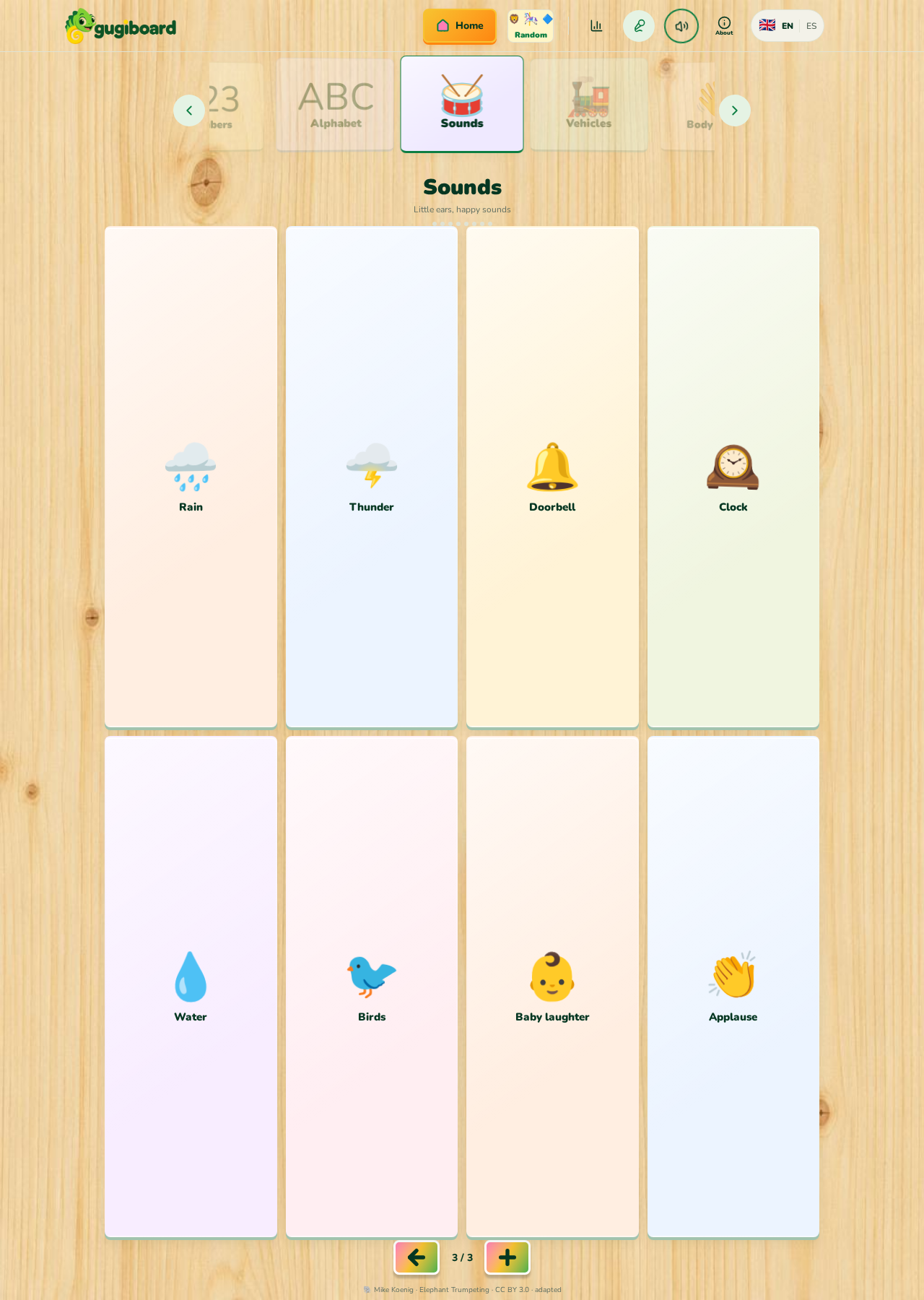
The sound collection in gugiboard extends beyond animals and musical instruments. Another sheet brings familiar events such as rain, a doorbell and water into the same touch-friendly format. Its practical advantage is listening to a short matching recording on demand, without waiting for that event to happen in the room. The clips are examples, not recordings of your home or a test of a child’s hearing.
Find the everyday-sounds sheet
Open Sounds and use the colorful + to move beyond the first animal and instrument sheet and the additional sound targets. The everyday sheet contains rain, thunder, doorbell, clock, water, birds, baby laughter and applause. A picture and label identify each choice. There is no need to listen to all eight; start with something your child recognizes or wants to hear.
The recording is different from a spoken name
Sounds plays the matching recording rather than pronouncing the selected label. That differs from vocabulary boards, where saved speech names an object. Rain remains a rain recording whether English or Spanish is selected; the label changes language. This distinction lets a family choose deliberately between hearing what something is called and hearing an example of the sound associated with it.
Listen to one clip at a time
Tapping a new sound stops the preceding recording rather than layering a growing collection of clips. You can replay a choice when wanted, and mute stops the sound. Keep the volume comfortable; a recording of thunder may be unwelcome for some children. If a sound causes discomfort, stop it rather than insisting that the child become accustomed to it.
Music and sound have different roles
The speaker menu lets you choose background music separately from the board’s recordings and spoken words. No music stops only the background music; mute is the choice for quiet play. For a listening moment, turning background music off can make the selected clip easier to distinguish. This is a practical preference, not a claim about improving hearing or concentration.
Connect a clip with the real world
After a brief shared listen, notice an appropriate real event together: water flowing while an adult manages a tap, birds outside or a clock in the room. Real sounds vary; your doorbell need not match the recording. Never create loud bangs or expose a child to a storm to reproduce a clip. A quiet conversation or picture book is also a suitable follow-up.
Recordings prepared before play
The sound targets use saved recordings delivered with the platform’s content. They do not record your child or generate new audio live during play. This gives each target a consistent example to replay, but it does not guarantee every sound will load without a connection problem. Consult the Privacy Policy for device data, and use the collection as optional shared listening rather than a diagnostic tool.
Source and privacy
More play ideas
- Toddler browser games: a caregiver’s guide to shared play
- Colors and shapes for toddlers: simple ways to play together
- English and Spanish animal play: words, sounds and movement
- Play that moves on by itself: auto-advance and idle friends
- See what your toddler taps most—and hide it with one tap
- A visual tour of gugiboard: boards, Baby Games and Little favorites
- First words with jungle animals: lion, elephant, monkey and friends
- Alphabet play in two languages: from A for Apple to Ñ
- Happy, sad, surprised: naming feelings with toddlers
- Eyes, nose, hands: body parts games for toddlers
- Kindness through play: rescue stories for little helpers
- Cause and effect: why busy boards fascinate babies
- Music and sounds for babies: instruments, animals and soft songs
- Wake up to bedtime: teaching daily routines with Tiny House
- Tap, drag, draw: little fingers and fine motor play
- Healthy screen habits for toddlers: short, shared and balanced
- Play ideas by age: how gugiboard grows with your child from 0 to 7
- Counting with stars: first numbers through play
- Red, blue, yellow: learning colors step by step
- Circles, stars and hearts: finding shapes all around us
- Raising bilingual children at home: simple daily habits
- Sensory play for babies: lights, sounds and gentle movement
- gugiboard for children aged 4 to 7: from play to early learning
- “Great job!”: celebrating effort, not just results
- Calm moments: helping little ones through big feelings
- Meet the gugiboard chameleon: friendly characters that invite play
- From an animal picture to a story: reading picture books together
- Your turn, my turn: sharing play without a race
- Inside, outside, above and below: discovering spatial words
- Red, blue, red: noticing patterns without worksheets
- Where shall we go? Pretend journeys with vehicles and stories
- “What do you notice?” Questions that leave room for curiosity
- One last turn: helping children move from play to the next activity
- Different ways to join in: adapting shared play to your child
- Big sibling, little sibling: playing together without comparing scores
- A little garden story: noticing plants and practising care
- Zip & Clothes in gugiboard: familiar fasteners, clear little actions
- Little Workshop: what moves, opens and changes in gugiboard
- Inside Tiny House: everyday objects you can explore in gugiboard
- Circus & Sky and Circus Surprise: two playful worlds in gugiboard
- Light Factory in gugiboard: a light chain and a traffic-light scene
- Ball Adventure: big, small, slow and fast in gugiboard
- Domino Parade in gugiboard: one touch, a moving chain and bells
- What the colorful + opens in gugiboard: more content, familiar play
- Fruits & Food in gugiboard: pictures, words and everyday connections