
Light Factory in gugiboard: a light chain and a traffic-light scene
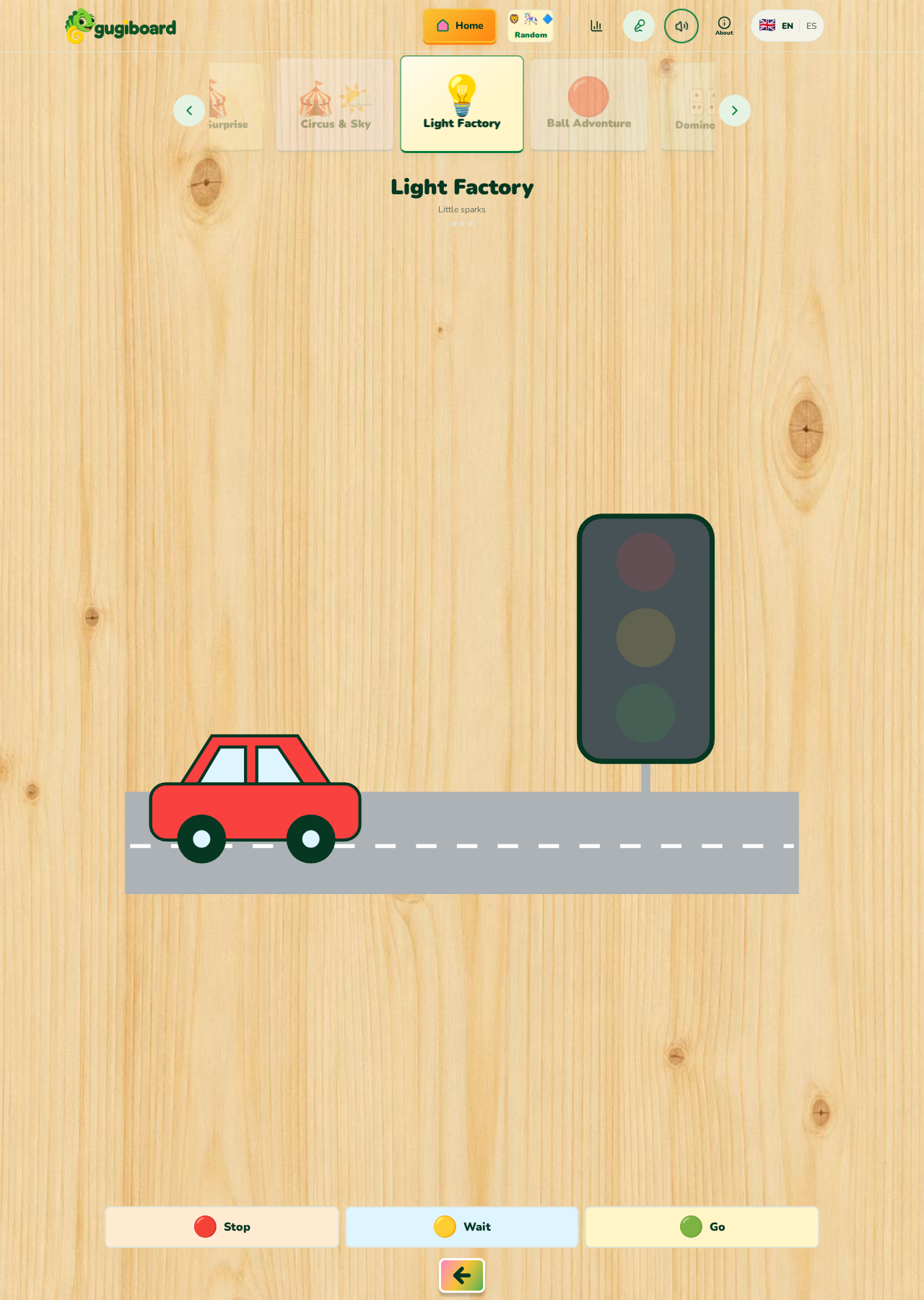
A light changing after a touch is an easy event to notice. Light Factory builds a larger animated scene around that idea, then adds a traffic-light picture through its colorful +. Within gugiboard, the same board can therefore support two different conversations: what happens after an action, and how colored signals differ. Its advantage is a clear visual comparison, not a claim that playing teaches road safety.
Follow the main light sequence
The main scene offers Light chain, Reverse gears and Sparkle party choices. They start animated reactions involving the machine’s lights and movement. Choose one, watch together and describe a visible change. The result is more useful as something to discuss than as a task to finish quickly; no explanation or spoken answer is required from the child.
Separate a chain from an independent light
Light Factory is about a linked animated reaction. gugiboard also has a separate Colored Light Bulbs board, where individual bulbs can be switched independently. That difference matters when choosing an activity: one offers a sequence to watch, the other individual changes to control. Both can be explored without assuming they provide the same experience or teach the same thing.
Open the traffic-light picture
The colorful + on Light Factory shows a car, a traffic light and three choices: Stop, Wait and Go. Each choice changes the visible signal and the car’s response. Try one at a time and comment on what changed. The controls put the comparison in a single scene, rather than making a child navigate several separate pictures.
Name colors and actions together
You can describe “red, stop” or “green, go” in the selected language, using the board’s prepared recordings where spoken labels are played. Spanish gives parar, esperar and avanzar for the corresponding actions. Follow the family’s own language habits and allow time to observe. These examples are vocabulary opportunities, not an assessment of understanding or an instruction to repeat words correctly.
Keep real traffic rules separate
A simplified signal animation cannot explain every crossing, road situation or local traffic rule. Never ask a child to apply the game independently near a road. Real journeys require an adult’s supervision and appropriate local guidance. If you discuss a signal during a walk, do so from a safe place and explain that decisions about crossing belong to the responsible adult.
Use a short comparison, then move on
A family can try two contrasting choices and finish, even if the screen offers more. Home remains available throughout play, and music can be stopped without silencing spoken words. The page is free to open in a browser without a required account. Its convenience lies in accessible examples for shared observation, not in replacing real experiences or extending screen time.
Source and privacy
More play ideas
- Toddler browser games: a caregiver’s guide to shared play
- Colors and shapes for toddlers: simple ways to play together
- English and Spanish animal play: words, sounds and movement
- Play that moves on by itself: auto-advance and idle friends
- See what your toddler taps most—and hide it with one tap
- A visual tour of gugiboard: boards, Baby Games and Little favorites
- First words with jungle animals: lion, elephant, monkey and friends
- Alphabet play in two languages: from A for Apple to Ñ
- Happy, sad, surprised: naming feelings with toddlers
- Eyes, nose, hands: body parts games for toddlers
- Kindness through play: rescue stories for little helpers
- Cause and effect: why busy boards fascinate babies
- Music and sounds for babies: instruments, animals and soft songs
- Wake up to bedtime: teaching daily routines with Tiny House
- Tap, drag, draw: little fingers and fine motor play
- Healthy screen habits for toddlers: short, shared and balanced
- Play ideas by age: how gugiboard grows with your child from 0 to 7
- Counting with stars: first numbers through play
- Red, blue, yellow: learning colors step by step
- Circles, stars and hearts: finding shapes all around us
- Raising bilingual children at home: simple daily habits
- Sensory play for babies: lights, sounds and gentle movement
- gugiboard for children aged 4 to 7: from play to early learning
- “Great job!”: celebrating effort, not just results
- Calm moments: helping little ones through big feelings
- Meet the gugiboard chameleon: friendly characters that invite play
- From an animal picture to a story: reading picture books together
- Your turn, my turn: sharing play without a race
- Inside, outside, above and below: discovering spatial words
- Red, blue, red: noticing patterns without worksheets
- Where shall we go? Pretend journeys with vehicles and stories
- “What do you notice?” Questions that leave room for curiosity
- One last turn: helping children move from play to the next activity
- Different ways to join in: adapting shared play to your child
- Big sibling, little sibling: playing together without comparing scores
- A little garden story: noticing plants and practising care
- Zip & Clothes in gugiboard: familiar fasteners, clear little actions
- Little Workshop: what moves, opens and changes in gugiboard
- Inside Tiny House: everyday objects you can explore in gugiboard
- Circus & Sky and Circus Surprise: two playful worlds in gugiboard
- Ball Adventure: big, small, slow and fast in gugiboard
- Domino Parade in gugiboard: one touch, a moving chain and bells
- What the colorful + opens in gugiboard: more content, familiar play
- Fruits & Food in gugiboard: pictures, words and everyday connections
- Rain, a clock and a doorbell: everyday sounds in gugiboard