
Ball Adventure: big, small, slow and fast in gugiboard
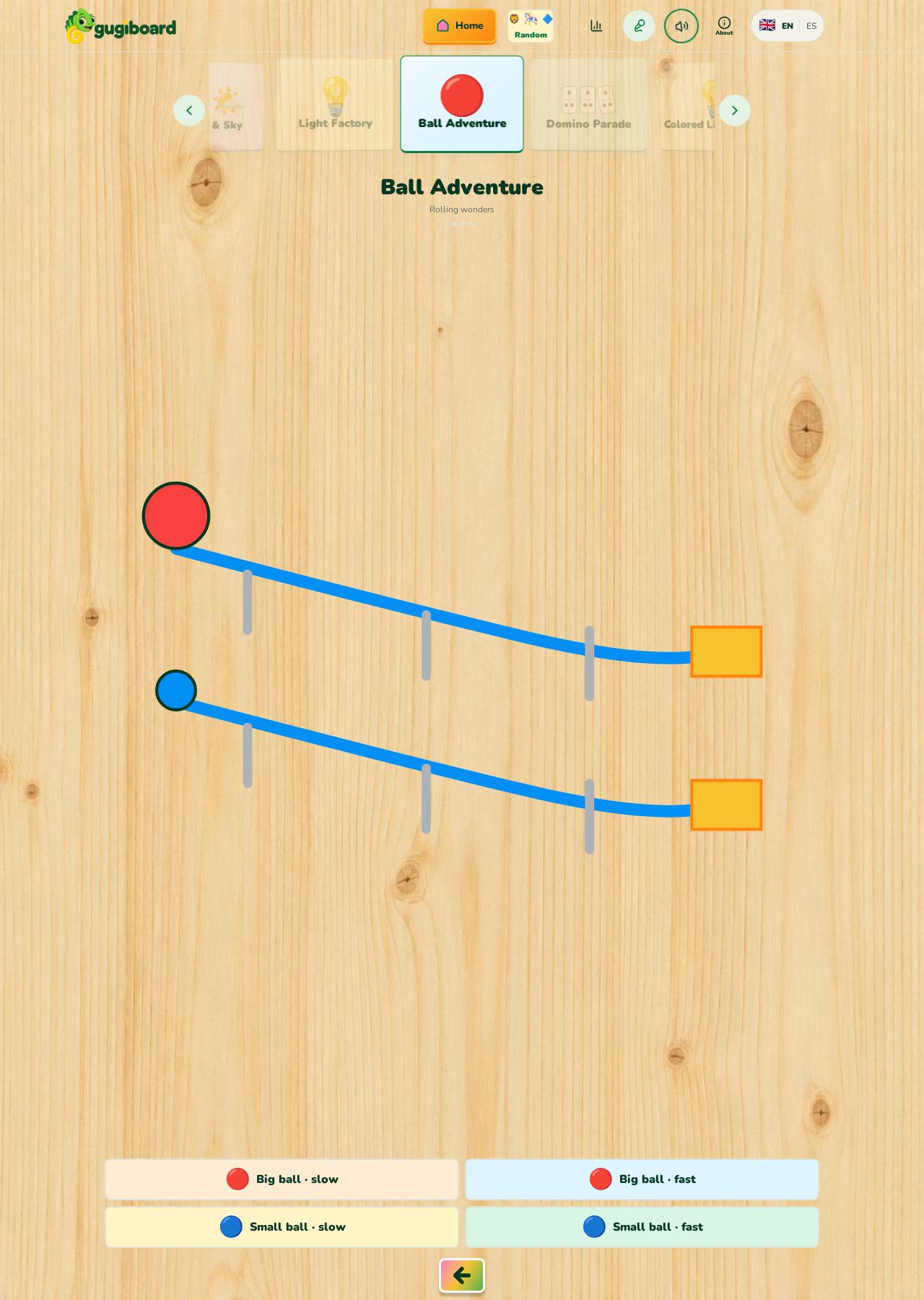
Two balls can look different in size and move differently in time. Ball Adventure makes those differences visible through animated routes and a colorful + scene. It is part of gugiboard’s free collection of interactive boards. A family can compare one change at a time without preparing a physical ramp, while remembering that a screen animation is a simplified example rather than a model of every real ball.
Watch where the ball travels
The main board offers Rolling ball, Another path and Bouncy ball. These choices change the route or animated response in the scene. Choose one and follow the ball together, describing where it goes. If your child points to the destination instead of the ball, follow that observation too. There is no need to narrate every movement or ask for predictions.
The extra sheet introduces comparisons
Open the colorful + to find a size-and-speed ramp scene. Choices combine big or small balls with slow or fast motion. Because these comparisons share one setting, you can talk about the changed feature without switching to a completely different activity. Start with two contrasting options and leave the others for another day if interest fades.
Change one feature at a time
For a clear size comparison, choose a big ball and a small ball using the same speed description. For a speed comparison, keep the size and change slow to fast. Say what you observe rather than asking a child to identify the right answer. The animation provides examples of contrast; it does not measure a child’s knowledge or reaction time.
Use simple English–Spanish pairs
Big and grande, small and pequeña, slow and lenta, fast and rápida can be placed in a short phrase about the ball. The app’s labels and saved speech follow the language selection. Use one familiar language first if that makes the conversation easier. A child can participate by watching or pointing without repeating the words or completing all the combinations.
Try a gentle real-ball follow-up
Put the screen aside and roll a large soft ball across a clear floor toward another person. An adult can vary the push gently and describe the difference. Keep the area away from stairs and fragile objects, and use age-appropriate balls too large to swallow. Real motion depends on the surface and the push, which a simplified game does not fully represent.
Why the comparison is practical
Ball Adventure offers ready-to-open visual examples, an extra scene in the same board and familiar navigation back to Home. It can be convenient when you want one short shared comparison rather than a long game. It is not a promise of better coordination or faster learning. Choose real movement and face-to-face play whenever those meet your family’s needs better.
Source and privacy
More play ideas
- Toddler browser games: a caregiver’s guide to shared play
- Colors and shapes for toddlers: simple ways to play together
- English and Spanish animal play: words, sounds and movement
- Play that moves on by itself: auto-advance and idle friends
- See what your toddler taps most—and hide it with one tap
- A visual tour of gugiboard: boards, Baby Games and Little favorites
- First words with jungle animals: lion, elephant, monkey and friends
- Alphabet play in two languages: from A for Apple to Ñ
- Happy, sad, surprised: naming feelings with toddlers
- Eyes, nose, hands: body parts games for toddlers
- Kindness through play: rescue stories for little helpers
- Cause and effect: why busy boards fascinate babies
- Music and sounds for babies: instruments, animals and soft songs
- Wake up to bedtime: teaching daily routines with Tiny House
- Tap, drag, draw: little fingers and fine motor play
- Healthy screen habits for toddlers: short, shared and balanced
- Play ideas by age: how gugiboard grows with your child from 0 to 7
- Counting with stars: first numbers through play
- Red, blue, yellow: learning colors step by step
- Circles, stars and hearts: finding shapes all around us
- Raising bilingual children at home: simple daily habits
- Sensory play for babies: lights, sounds and gentle movement
- gugiboard for children aged 4 to 7: from play to early learning
- “Great job!”: celebrating effort, not just results
- Calm moments: helping little ones through big feelings
- Meet the gugiboard chameleon: friendly characters that invite play
- From an animal picture to a story: reading picture books together
- Your turn, my turn: sharing play without a race
- Inside, outside, above and below: discovering spatial words
- Red, blue, red: noticing patterns without worksheets
- Where shall we go? Pretend journeys with vehicles and stories
- “What do you notice?” Questions that leave room for curiosity
- One last turn: helping children move from play to the next activity
- Different ways to join in: adapting shared play to your child
- Big sibling, little sibling: playing together without comparing scores
- A little garden story: noticing plants and practising care
- Zip & Clothes in gugiboard: familiar fasteners, clear little actions
- Little Workshop: what moves, opens and changes in gugiboard
- Inside Tiny House: everyday objects you can explore in gugiboard
- Circus & Sky and Circus Surprise: two playful worlds in gugiboard
- Light Factory in gugiboard: a light chain and a traffic-light scene
- Domino Parade in gugiboard: one touch, a moving chain and bells
- What the colorful + opens in gugiboard: more content, familiar play
- Fruits & Food in gugiboard: pictures, words and everyday connections
- Rain, a clock and a doorbell: everyday sounds in gugiboard