
Domino Parade in gugiboard: one touch, a moving chain and bells
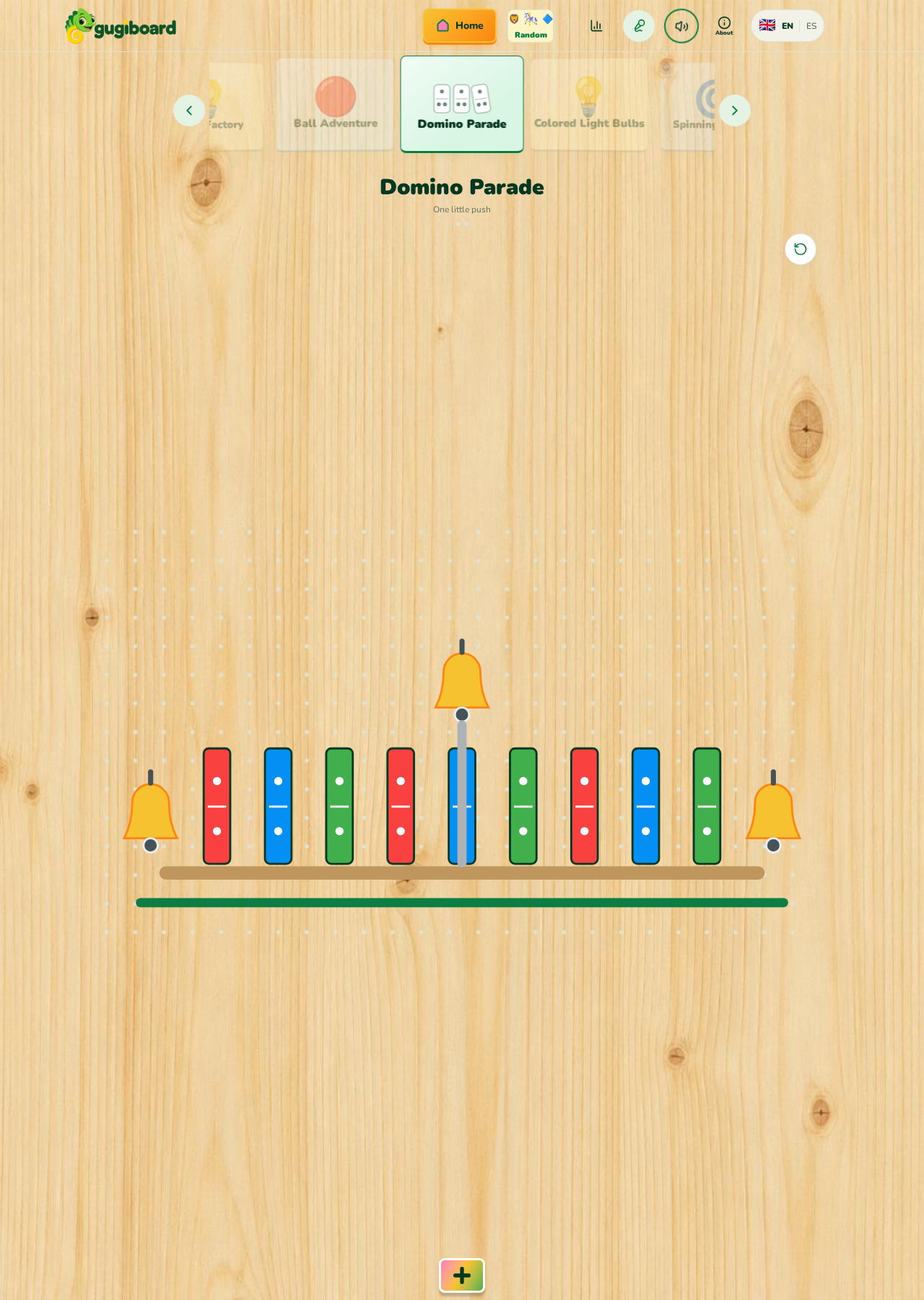
A single domino falling into the next creates a sequence that can be followed with the eyes. Domino Parade offers a digital version inside gugiboard, complete with bells and an extra path. Its advantage is being able to revisit the movement without rebuilding a line of physical pieces. The scene is a playful representation of a chain reaction, not an explanation of all the forces involved.
Begin from either side
The main scene uses direct touch on the left or right domino rather than separate arrow commands. The chosen starting side changes how the sequence begins. Watch one run and name the direction informally: “It starts here.” You do not have to ask the child to predict every falling piece, or make starting the chain into a speed challenge.
Listen to the moving bells
Bells at the sides and in the middle add recordings that accompany their movement. This links a visible event with an audible response, unlike a generic sound playing independently of the scene. Keep the volume comfortable and use mute when wanted. Watching silently is still a valid way to share the activity; the sound does not need to stay on.
Follow an extra winding route
The colorful + opens another domino scene with a winding S-shaped chain. It starts lower down and continues toward a switch that turns on a light. That gives the sequence a different visible ending, not just a new background. You can follow the first piece, then notice the final light, without narrating every intermediate domino as it falls.
Talk about first and next
A short comment such as “This one fell, then that one” can make the order easier to discuss. If your child only wants to restart the movement, allow that choice. The app’s familiar English–Spanish controls let the family keep their chosen language, but the sequence is not a formal lesson in counting or a test of understanding cause and effect.
A real-world version is optional
After a short screen turn, an adult and an older child might make a small line with suitable large blocks on a stable surface. Keep pieces appropriate for age and supervise; ordinary small dominoes may not be suitable for younger children. A real line can fall differently from the animation, which is a chance to notice rather than an error to correct.
Convenience without pressure to finish
Domino Parade is part of the free browser platform, with reset and navigation available during play. It saves setup time when the aim is simply to watch a chain and talk together. It does not replace hands-on building or promise a particular skill. Stop at a comfortable point, even after one run, and let the next activity happen away from the screen.
Source and privacy
More play ideas
- Toddler browser games: a caregiver’s guide to shared play
- Colors and shapes for toddlers: simple ways to play together
- English and Spanish animal play: words, sounds and movement
- Play that moves on by itself: auto-advance and idle friends
- See what your toddler taps most—and hide it with one tap
- A visual tour of gugiboard: boards, Baby Games and Little favorites
- First words with jungle animals: lion, elephant, monkey and friends
- Alphabet play in two languages: from A for Apple to Ñ
- Happy, sad, surprised: naming feelings with toddlers
- Eyes, nose, hands: body parts games for toddlers
- Kindness through play: rescue stories for little helpers
- Cause and effect: why busy boards fascinate babies
- Music and sounds for babies: instruments, animals and soft songs
- Wake up to bedtime: teaching daily routines with Tiny House
- Tap, drag, draw: little fingers and fine motor play
- Healthy screen habits for toddlers: short, shared and balanced
- Play ideas by age: how gugiboard grows with your child from 0 to 7
- Counting with stars: first numbers through play
- Red, blue, yellow: learning colors step by step
- Circles, stars and hearts: finding shapes all around us
- Raising bilingual children at home: simple daily habits
- Sensory play for babies: lights, sounds and gentle movement
- gugiboard for children aged 4 to 7: from play to early learning
- “Great job!”: celebrating effort, not just results
- Calm moments: helping little ones through big feelings
- Meet the gugiboard chameleon: friendly characters that invite play
- From an animal picture to a story: reading picture books together
- Your turn, my turn: sharing play without a race
- Inside, outside, above and below: discovering spatial words
- Red, blue, red: noticing patterns without worksheets
- Where shall we go? Pretend journeys with vehicles and stories
- “What do you notice?” Questions that leave room for curiosity
- One last turn: helping children move from play to the next activity
- Different ways to join in: adapting shared play to your child
- Big sibling, little sibling: playing together without comparing scores
- A little garden story: noticing plants and practising care
- Zip & Clothes in gugiboard: familiar fasteners, clear little actions
- Little Workshop: what moves, opens and changes in gugiboard
- Inside Tiny House: everyday objects you can explore in gugiboard
- Circus & Sky and Circus Surprise: two playful worlds in gugiboard
- Light Factory in gugiboard: a light chain and a traffic-light scene
- Ball Adventure: big, small, slow and fast in gugiboard
- What the colorful + opens in gugiboard: more content, familiar play
- Fruits & Food in gugiboard: pictures, words and everyday connections
- Rain, a clock and a doorbell: everyday sounds in gugiboard