
Fruits & Food in gugiboard: pictures, words and everyday connections
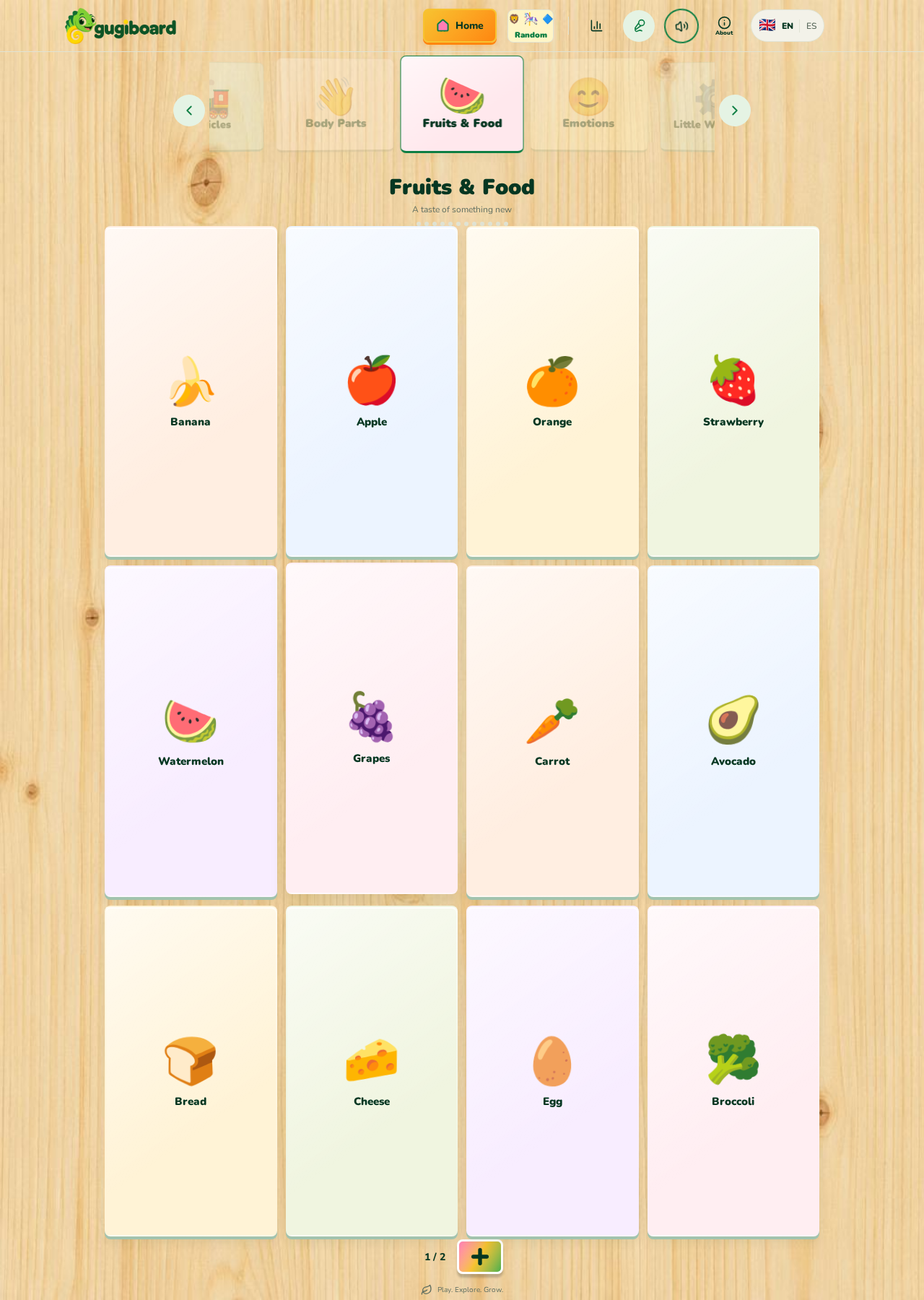
An apple on a screen cannot smell or taste like an apple in the kitchen, but it can begin a conversation about something familiar. Fruits & Food brings food illustrations, saved names and touch interactions into gugiboard. Its advantage is offering a ready collection of pictures in two languages. Use that collection for noticing and conversation, not as a feeding program, nutrition plan or way to pressure a child into eating.
A mixed collection, not only fruit
The first sheet includes banana, apple, orange, strawberry, watermelon and grapes alongside carrot, avocado, bread, cheese, egg and broccoli. The mixed selection makes the board broader than its fruit pictures alone. Choose a food your child recognizes and comment on a detail. Not every family eats every item, and that is not a problem to solve through the game.
Touch, see it larger and move it
Choosing a food opens an enlarged target that can be moved with a finger. The larger view gives one object more visual space, while the original sheet remains the place to return to. You might describe its shape or color without asking the child to identify it. Moving the illustration is play, not practice for using utensils or preparing ingredients.
The extra sheet adds familiar foods
The colorful + brings milk, water, rice, soup, pear, pineapple, tomato, pasta, cookie and yogurt. These are additional examples within the same board format. Compare one item with something your family already uses, or choose a picture because it is unfamiliar. The collection is not a balanced menu and does not prescribe what a child should eat or drink.
Listen to names in two languages
The language switch changes labels and prepared spoken names. Apple and manzana or water and agua can become a simple pair in a sentence. Use the language that feels natural and select a preferred recorded voice. The app does not check pronunciation or decide whether a food has been learned; a pointed finger or a curious look is enough participation.
Connect with a real meal gently
An adult can point to a similar food at the next meal: “Here is the apple we saw.” Keep the invitation neutral and do not make tasting the price of playing. Real food should be prepared appropriately for the child, with relevant allergy and choking precautions. The page offers no individual feeding advice; ask a qualified professional about concerns or dietary needs.
Why pictures can be convenient
The board lets a family find related food pictures without collecting packaging or opening several websites. Home, language and sound controls stay within reach. It is free browser play without a required account, but not a replacement for shared meals and real sensory experiences. Stop the optional screen moment when it has served the conversation, and let the child’s comfort guide what comes next.
Source and privacy
More play ideas
- Toddler browser games: a caregiver’s guide to shared play
- Colors and shapes for toddlers: simple ways to play together
- English and Spanish animal play: words, sounds and movement
- Play that moves on by itself: auto-advance and idle friends
- See what your toddler taps most—and hide it with one tap
- A visual tour of gugiboard: boards, Baby Games and Little favorites
- First words with jungle animals: lion, elephant, monkey and friends
- Alphabet play in two languages: from A for Apple to Ñ
- Happy, sad, surprised: naming feelings with toddlers
- Eyes, nose, hands: body parts games for toddlers
- Kindness through play: rescue stories for little helpers
- Cause and effect: why busy boards fascinate babies
- Music and sounds for babies: instruments, animals and soft songs
- Wake up to bedtime: teaching daily routines with Tiny House
- Tap, drag, draw: little fingers and fine motor play
- Healthy screen habits for toddlers: short, shared and balanced
- Play ideas by age: how gugiboard grows with your child from 0 to 7
- Counting with stars: first numbers through play
- Red, blue, yellow: learning colors step by step
- Circles, stars and hearts: finding shapes all around us
- Raising bilingual children at home: simple daily habits
- Sensory play for babies: lights, sounds and gentle movement
- gugiboard for children aged 4 to 7: from play to early learning
- “Great job!”: celebrating effort, not just results
- Calm moments: helping little ones through big feelings
- Meet the gugiboard chameleon: friendly characters that invite play
- From an animal picture to a story: reading picture books together
- Your turn, my turn: sharing play without a race
- Inside, outside, above and below: discovering spatial words
- Red, blue, red: noticing patterns without worksheets
- Where shall we go? Pretend journeys with vehicles and stories
- “What do you notice?” Questions that leave room for curiosity
- One last turn: helping children move from play to the next activity
- Different ways to join in: adapting shared play to your child
- Big sibling, little sibling: playing together without comparing scores
- A little garden story: noticing plants and practising care
- Zip & Clothes in gugiboard: familiar fasteners, clear little actions
- Little Workshop: what moves, opens and changes in gugiboard
- Inside Tiny House: everyday objects you can explore in gugiboard
- Circus & Sky and Circus Surprise: two playful worlds in gugiboard
- Light Factory in gugiboard: a light chain and a traffic-light scene
- Ball Adventure: big, small, slow and fast in gugiboard
- Domino Parade in gugiboard: one touch, a moving chain and bells
- What the colorful + opens in gugiboard: more content, familiar play
- Rain, a clock and a doorbell: everyday sounds in gugiboard